Does the camera really add five pounds? Is your good side really your good side? Six behind-the-camera truths your videographer is thinking about on every shoot.
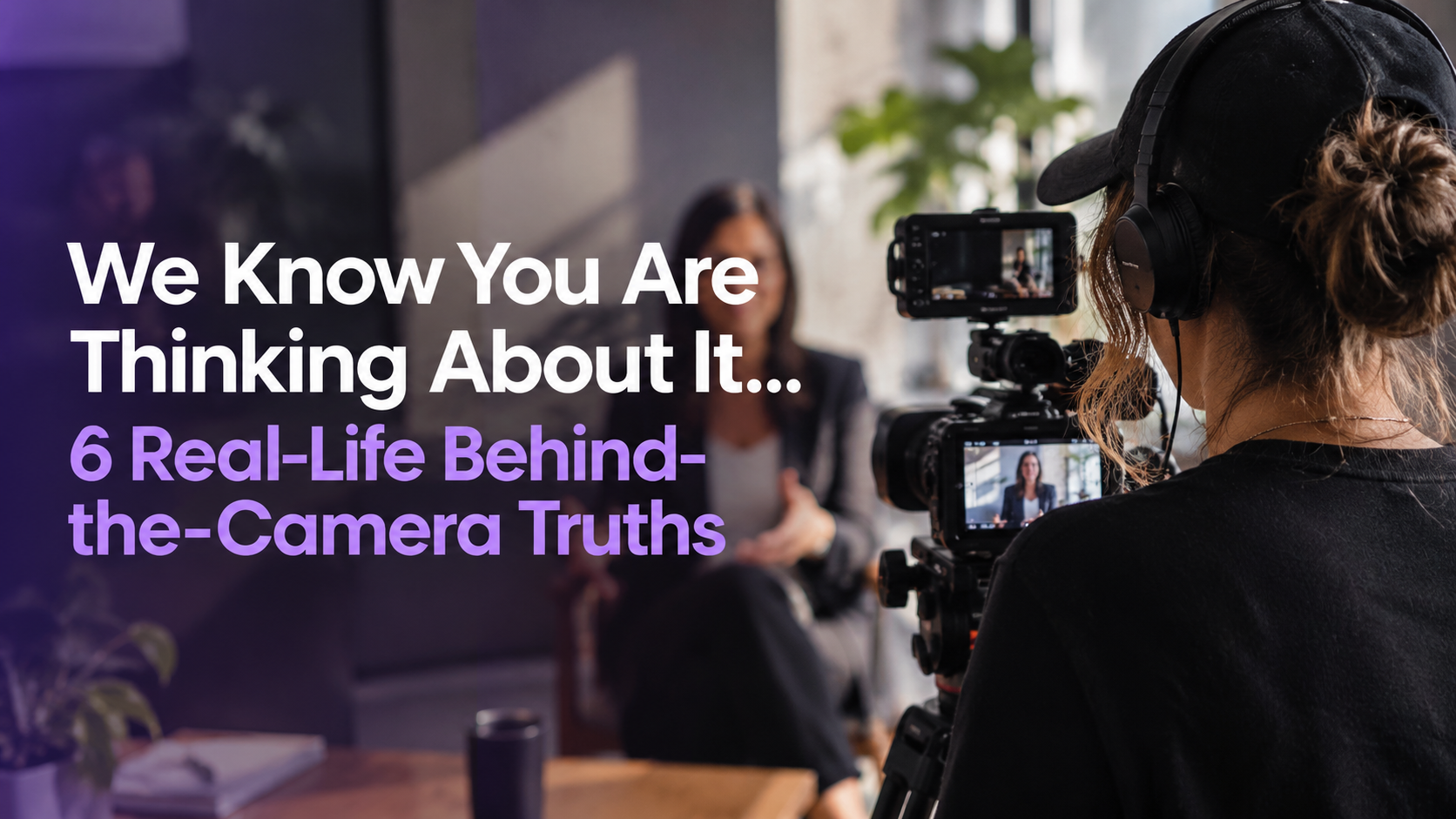
Does the camera really add five pounds?
Is your left side actually your “good side”?
Why does your voice sound so strange when you hear it recorded?
And why is your videographer asking you to do something that feels completely unnecessary, like take a big pause?
If you've ever been filming a video and wondered what your videographer was thinking, you're not alone.
Professional videographers make dozens of decisions that most customers never see. They're thinking about lenses, lighting, composition, audio, movement, continuity, storytelling, and ultimately how every shot will work in the final edit.
Here are six behind-the-camera truths videographers know that customers often don't, but are definitely thinking.
Not exactly.
The idea that “the camera adds five pounds” is mostly a myth.
However, camera setup absolutely affects how your body and face appear on video.
Lens choice, focal length, camera distance, camera height, lighting, angle, posture, and even clothing can change how someone looks on screen.
That's why a professional videographer doesn't simply point a camera at you.
They consider:
The camera isn't necessarily making you look different.
The way the camera is being used is, and how you prepare for filming is too.
Most people have a side of their face they prefer.
But the side you like in a mirror isn't necessarily the side that will look best on camera.
Why?
Because video films your face in three dimensions, under specific lighting, from a specific angle, with movement.
Your videographer is looking at things you may not notice:
So if your videographer asks you to turn slightly to the left, there's probably a reason. Do not hesitate to watch back some of your takes to see how everything is shaping up yourself.
This is one of the biggest misconceptions in video production.
People often obsess over camera resolution, lenses, and image quality while overlooking audio.
But poor audio can make otherwise beautiful videos difficult to watch.
For interviews, testimonials, presentations, events, and social media content, clear dialogue is essential.
That's why professional video production pays attention to:
A beautiful 4K video with distracting audio is still a bad viewing experience. Good video needs good sound.
One of the biggest misconceptions about being on camera is that you need to nail your lines immediately, say everything perfectly the first time, or keep your composure unnaturally. You don't.
Professional video production is designed around the fact that humans are human.
You may:
That's normal.
A good videographer can simply say:
“Let's do that again.”
Sometimes the second, third, or fourth take is the one that feels the most natural. That is the goal, keep going or move on if it is getting frustrating.
Some of the most valuable moments when filming happen between the ‘official’ moments.
The laugh after the interview.
The walk into the room.
Someone interacting naturally with a customer.
Hands moving while someone talks.
A reaction.
A quick glance.
A spontaneous interaction.
These moments are often called B-roll, and they can be incredibly valuable during editing.
B-roll gives editors visual material to layer over dialogue, create transitions, establish context, and make a video feel more dynamic.
In other words:
Don't stop filming just because the “main thing” is over.
This is perhaps the biggest behind-the-scenes secret.
Your videographer isn't only asking:
“Does this shot look good?”
They're also asking:
“How is this going to cut together?”
They may be thinking about:
That's why professional video production is about much more than operating a camera.
You're filming the raw materials for a polished edit.
The best video content happens when the customer and creative professional understand that they're working toward the same finished product.
The customer brings the:
Vision + expertise + story
The videographer brings the:
Creative direction + technical skill + perspective
The editor brings the:
Storytelling + pacing + structure
And the production system brings:
Organization + accessibility + efficiency
At Blended Sense, that's the bigger idea behind our model.
We connect businesses with vetted creative professionals through our nationwide network and provide the technology and workflow through STUDIO to help move content from filming to a finished, ready-to-publish asset.
Because filming video content shouldn't end with just a folder full of footage.
It should be the beginning of something you can actually use. Again and again.
The next time you're filming video, remember:
Your videographer isn't just filming what is happening.
They're thinking about what the audience will eventually see.
They're watching the light.
Listening to the audio.
Thinking about the edit.
Looking for the unexpected moment.
And quietly building the pieces that will eventually become your finished content.
The world is your studio. We just help you film it.
Create your Studio account and start ordering the content your brand needs, anytime, anywhere.
Create your account →
Business
A step-by-step guide to speaking on camera with authenticity so your audience truly connects with you.
embody-authenticity-mastering-the-art-of-speaking-on-camera
Business
Not sure what to order from your raw footage? This guide breaks down exactly what to order based on the type of Sweep you had, with pricing and reasoning for every asset.
what-should-i-order-sweep-guide
Creative
Traditional video production comes with sky-high invoices, six-week timelines, and footage you may never see again. Here's how Blended Sense built a better way to get ongoing video for your business, brand, or event.
real-cost-of-traditional-video-production