Blended Sense co-founders join the Momentum Builder Podcast to unpack why video has to run as infrastructure, not a one-time campaign.
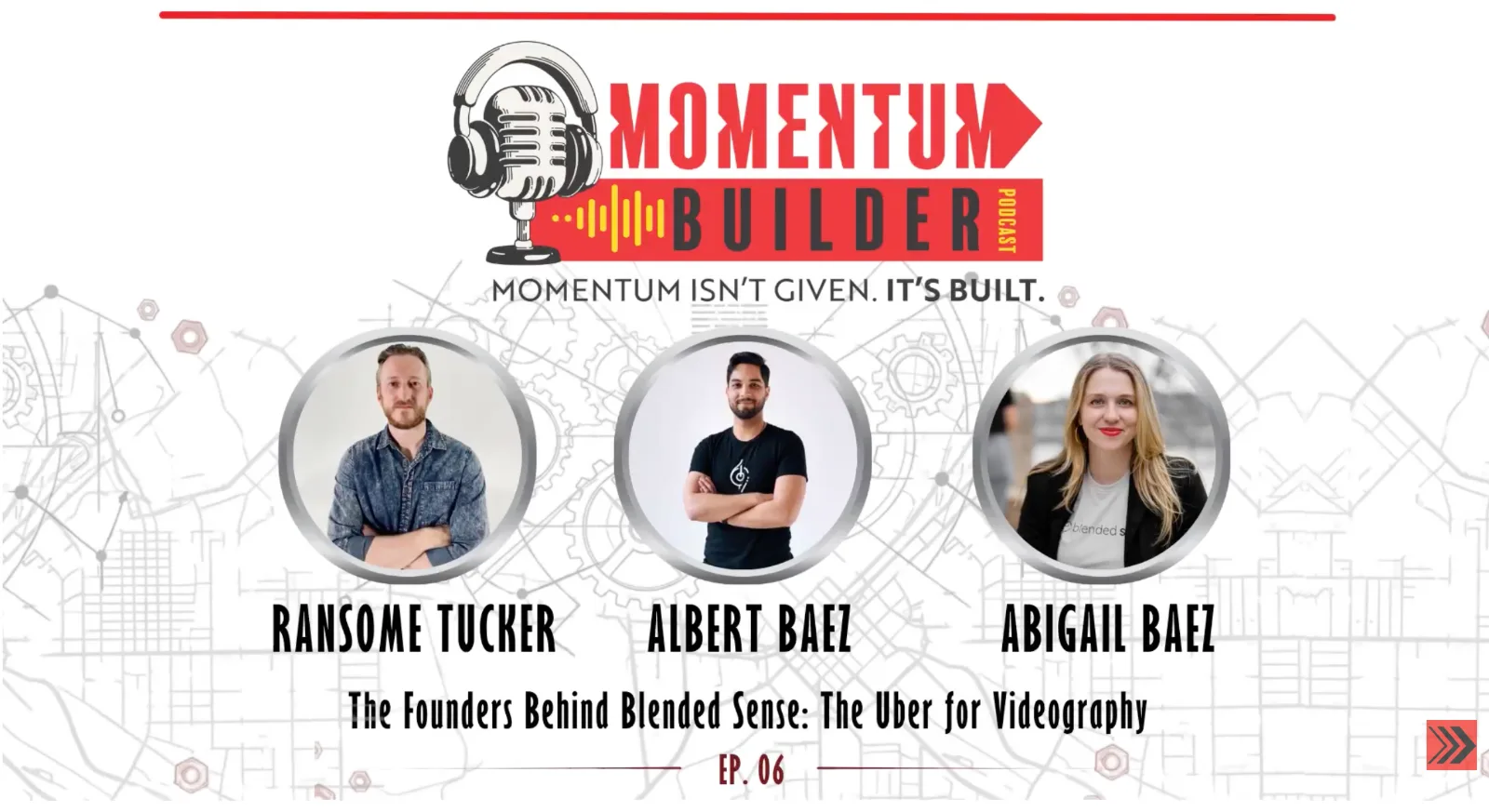
When every business suddenly became a media company, most were left scrambling. Consistent, high-quality video became a requirement, not a nice-to-have, and the tools to produce it at scale simply were not built for real businesses in the real world.
That is exactly what our team dug into on the Momentum Builder Podcast. Host Don Goettling sat down with Blended Sense co-founders Albert Baez and Abigail Baez, along with Ransome Tucker, to talk about how they built what they call the "Uber of videography," and why video has to be treated as infrastructure, not a one-time campaign.
Listen to the full episode here: https://www.youtube.com/watch?v=zqlneftEI9I
The modern consumer expects to interact with brands through digital and video-first experiences. That expectation did not arrive gradually. It became the baseline, and then 2020 pushed the online video world of commerce over the edge.
As Albert put it on the episode:
"The consumer has evolved to a point where they want to communicate with brands and businesses via the digital format."
It's fast and it scales.
The problem is that most businesses were never set up to meet that expectation. A local shop owner or a mid-market company now needs the kind of ongoing content output that used to belong to brands with full production teams. The demand changed overnight. But the way the video gets made did not.
Traditional production and agency models were built for Hollywood and big brands. They assume big budgets, long timelines, and one large campaign at a time. That model does not fit the business that needs steady, scalable content every single month.
The result is friction at every step: finding a videographer you trust, standardizing quality across shoots, managing the footage afterward, and turning any of it into something you can actually publish. For most owners, video became a source of stress instead of a source of growth.
Blended Sense's answer was to standardize the whole thing through a single platform. Instead of gambling on a new freelancer every time, businesses get access to a vetted, invite-only network of Creative Pros, now the largest network of vetted, invite-only videographers and hybrid creators in the world.
That standardization does more than guarantee quality. It removes friction, builds trust, and helps business owners feel genuinely comfortable and confident on camera. When the person behind the camera is vetted and the process is consistent, the whole experience changes for the customer.
This is also what makes "anytime, anywhere" camera access possible across markets, so a multi-location or enterprise brand can get the same standard of content in one city that it gets in another.
One of the biggest mindset shifts from the conversation: raw footage is a long-term business asset.
Using AI and technology to organize, tag, and repurpose that footage means a single Sweep (what we call our content session) can feed content for weeks or months. Instead of capturing video, using it once, and letting it disappear into a hard drive, teams can return to a tagged, organized library and repurpose it endlessly across channels.
That is the difference between spending on content and building an asset that keeps working.
The throughline of the episode is simple and worth sitting with: video becomes most powerful when it is operationally embedded into the business, the way SEO is.
It is not a one-time campaign. It is not a hope-it-goes-viral moment. It is an always-on system that supports how the business communicates, sells, and shows up for its audience. Once video is treated as infrastructure, it stops being a project you dread and starts being a channel you rely on.
Albert Baez and Ransome Tucker served as sales leaders for several nine-figure-exit companies in the marketing and ad tech space before setting out to modernize video. Alongside Albert's wife and co-founder, commercial film and TV actor Abigail Baez, they saw firsthand that while every business was being forced to become a media company, the production world was still antiquated, low-tech, and built for Hollywood budgets rather than real-world businesses.
Together they launched Blended Sense, recognized as the 2019 Startup of the Year out of Austin's global tech hub, Capital Factory. It runs on a proprietary, AI-powered video operating platform that standardizes filming, organizes and tags raw footage as a long-term asset, and enables reliable camera access anywhere. The mission behind it: empower creative entrepreneurship, give businesses dependable access to high-quality content, and stimulate local economies by connecting local creators with the brands that need them most.
If video is on your plate this year, this episode is worth the time. Don, Albert, Abigail, and Ransome get into the practical reality of scaling video content for real businesses, not just the theory.
🎧 Listen to the full episode: https://www.youtube.com/watch?v=zqlneftEI9I
The world is your studio. See how Blended Sense turns video into a system your business can actually run at studio.blendedsense.com.
Create your Studio account and start ordering the content your brand needs, anytime, anywhere.
Create your account →
Business
If you're relying solely on a content calendar to drive your video marketing, you're not alone, but you are leaving opportunity on the table.
content-calendar-isnt-a-business-strategy
Business
Finding a talented videographer isn't the hard part anymore. Finding one you can actually depend on is.
5-problems-scaling-with-freelance-creators
News
Blended Sense co-founder Albert Baez and President Ransome Tucker join the Prop Media Podcast to explain why video needs to run as a system, not a one-off project.
future-of-content-better-systems